Seasonal Guides
The Seasonal Fruit Calendar: What to Eat Each Month
A month-by-month guide to fruit at its peak in the Northern Hemisphere, with tips for buying in season.
El Madhoun Mohamed · August 28, 2026 · 9 min read
Buying Guides
Why do fruit prices change? Explore seasonality, weather, farming costs, transport, imports and retail pricing, plus practical ways to shop for better value.
By Frutino Editorial Team · Published October 14, 2026 · 9 min read
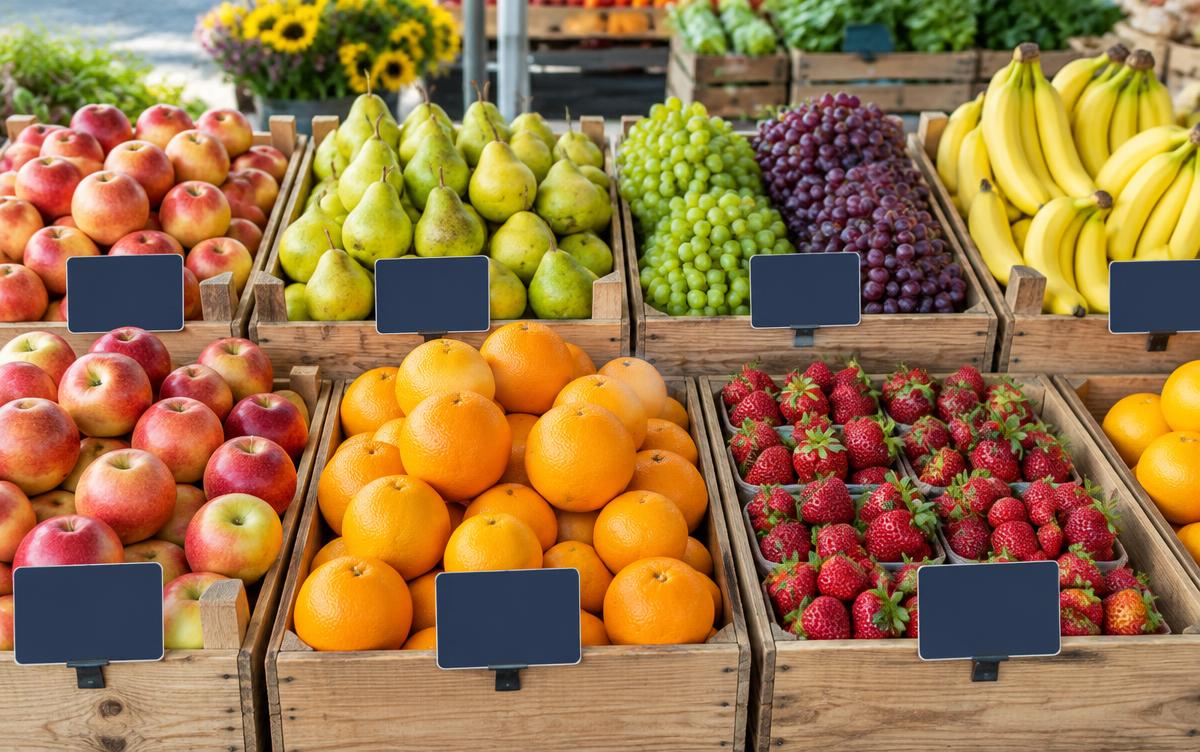
A box of strawberries can feel affordable one week and expensive the next. Apples from a nearby orchard may cost more than imported bananas, while two shops on the same street can charge different prices for apparently identical oranges. These differences are not explained by a single factor. The price you pay reflects how much fruit reaches the market, what it costs to grow and move it, how quickly it spoils, and how sellers compete for customers. Understanding that journey makes it easier to recognize good value without assuming that the cheapest fruit is always the best purchase. This guide explains the main forces behind fruit prices rather than forecasting prices in any particular country.
Fruit prices are shaped by supply and demand, but the supply that matters is usable fruit available in the right place at the right time. A large harvest somewhere in the world does not necessarily make fruit cheap in your neighborhood. Growers still need workers, packing facilities, transport and buyers, and some of the crop may not meet fresh-market requirements.
Demand means how much people are willing and able to buy at different prices. When customers want more of a fruit and supplies cannot increase quickly, prices can rise. When a large harvest arrives and sellers need to move perishable stock, prices may fall. Production and distribution costs influence what growers and sellers can sustainably offer, while competition and contracts influence the final shelf price.
Many fruits have a concentrated harvest season. During the local peak, more growers may bring the same fruit to market at once. Greater availability can put downward pressure on prices, especially for delicate fruit that cannot be stored for long. Early-season cherries or strawberries can command higher prices because supplies are still limited; prices may ease as harvesting becomes widespread.
Outside that season, shops may rely on stored fruit, imports from another climate, or protected cultivation. Each option brings a different cost structure. Apples can be kept in controlled storage, whereas fresh raspberries are much harder to hold for extended periods. This helps explain why some fruit prices remain relatively steady while others swing sharply.
Seasonal does not automatically mean cheapest. A poor local harvest can outweigh the usual seasonal advantage, and a supermarket promotion on imported fruit can undercut a local offer. Use seasonal calendars as a useful clue, then compare actual prices and condition.
A frost during flowering can reduce the number of fruit that develop. Drought can constrain irrigation and yields, excessive heat can damage quality, and heavy rain can interrupt harvesting or encourage decay. Storms may also disrupt roads and packing facilities even where fruit survives on the tree. The timing and severity of the event matter as much as the type of weather.
Pests and plant diseases can further reduce the quantity suitable for sale or increase the work needed to produce it. If several important growing regions are affected at once, finding replacement supplies becomes harder. However, a report of bad weather is not proof that every fruit price will rise: unaffected regions, existing stocks and imports may soften the impact.
Fruit trees also cannot be expanded overnight. Establishing an orchard and bringing it into production takes time, so growers may have limited options for responding to a sudden shortage. That slower adjustment is one reason a disrupted harvest can influence availability beyond the immediate week.
The orchard price has to support more than the fruit itself. Depending on the crop and farming system, growers pay for land, trees, irrigation, fertilizer, crop protection, equipment, maintenance, insurance and financing. Higher electricity or fuel costs can increase the expense of pumping water and operating machinery.
Labor is especially important for crops that require careful hand picking, repeated harvests, pruning or sorting. Small, fragile fruit may take more labor to harvest and handle than larger, sturdier fruit. Worker availability and wages therefore affect production costs, although the effect on shoppers depends on productivity, contracts and market conditions.
Higher costs do not translate into an identical or immediate increase at the checkout. Growers or sellers may absorb some of the change, and different parts of the supply chain may adjust at different times. Likewise, a lower retail price does not necessarily mean the farmer's costs have fallen.
Fruit must reach customers in saleable condition. That may involve sorting, packing, pre-cooling, refrigerated trucks, warehouses and carefully timed deliveries. Packaging helps protect delicate produce, but containers, labels and handling add costs. A small punnet of berries is not priced on fruit weight alone.
Distance is only part of the transport story. The shipping method, shipment size, route reliability and refrigeration needs all matter. Efficient bulk shipping over a long distance can sometimes cost less per unit than a small local delivery. Air-freighted fruit generally faces a very different cost structure from produce transported by ship or truck.
Fresh fruit is perishable, and not every item purchased by a seller will be sold. Bruising, dehydration, mold and unsold stock create losses that businesses must manage. Near-ripe fruit may be discounted to sell quickly, but a bargain that spoils before you eat it raises your effective cost. Assess freshness and your eating plans alongside the price label.
International trade allows shops to sell fruit beyond the domestic harvest season. Imported supplies can fill gaps and increase competition, sometimes limiting price rises after a local crop failure. They also bring exposure to conditions in exporting countries and disruptions along trade routes.
When fruit is purchased in a foreign currency, exchange-rate movements can change its cost in the buyer's currency. Import duties, inspection requirements, customs delays and trade restrictions can also affect cost or availability. The impact differs by country and product; it is not a fixed surcharge shared by all imported fruit.
Retail prices may react with a delay because importers have contracts, currency arrangements or stock already in transit. Check the country-of-origin label if you want to understand changing supplies, but do not assume that imported means expensive or local means cheap.
Two apples are not necessarily the same product. Variety, size, ripeness, consistency and visible condition affect how fruit is graded and marketed. Certain branded varieties can sell at a premium, and growers may receive different prices for fresh-market fruit than for fruit destined for processing.
Organic certification involves production and verification requirements, while yields and handling arrangements can differ from conventional systems. These factors can contribute to a price premium, but the size of that premium varies by crop and market. A higher price is not a simple measure of greater nutritional value.
Washed, peeled or sliced fruit includes additional preparation, packaging and refrigeration. Compare it with whole fruit as a convenience product, not just as the same fruit at a different price. Smaller or cosmetically imperfect fruit can be good value when it is sound and suited to your use; reject fruit that is moldy or showing signs of decay.
A shop's price includes its operating costs and commercial decisions. Rent, staffing, energy, stock losses and distribution arrangements vary between a neighborhood stall, a farmers' market and a large supermarket. The difference between the farm price and the shelf price pays for supply-chain services as well as business margins; it is not all profit.
Stores may discount a popular fruit to attract customers or negotiate large purchases for a promotion. Other shops may offer smaller volumes, different grades or a more convenient location. Holiday demand, local tastes and changing buying habits can also influence which fruit sells quickly and at what price.
A higher price at one shop is not, by itself, evidence of unfair pricing. First compare like with like: variety, origin, pack weight, quality and any membership conditions on the advertised offer. For the same reason, a sale sign is not enough to establish that a purchase is good value.
Start with the unit price: price per kilogram, pound or another common weight. A cheaper-looking packet can cost more per unit if it contains less fruit. When fruit is sold individually, differences in size can make the comparison less straightforward. Where the store provides unit pricing, use it to compare similar products.
For illustration only, imagine a 500-gram pack priced at 3 currency units and a 750-gram pack priced at 4. The first costs 6 per kilogram; the second costs about 5.33 per kilogram. The larger pack offers a lower price by weight, but only saves money if you use enough of it. These are hypothetical figures, not current market prices.
Edible yield matters too. Whole pineapple, a melon with a thick rind and a ready-to-eat berry pack do not provide the same amount of edible fruit per kilogram purchased. You do not need a complicated calculation for every shop: simply consider peel, pits, preparation and likely waste before choosing a bulk deal.
The best strategy is flexible rather than tied to one supposedly cheap fruit. Let good-quality seasonal offers influence your list, buy quantities you can realistically eat, and keep a few alternatives for weeks when your favorite fruit becomes expensive.
Fruit prices reflect a chain of decisions and constraints, from weather in the orchard to a promotion in your local shop. Seasonality and harvest size shape supply; labor, energy, transport and losses shape costs; and demand, imports and retail competition influence what reaches the shelf. No single factor explains every change, and this guide cannot predict next week's price. For everyday shopping, compare equivalent products, check unit prices and buy fruit you can actually use. Good value is the combination of an appropriate price, sound quality and little waste.
Harvest volumes, weather, delivery disruptions, promotions and demand can change quickly. Because many fruits have a short shelf life, sellers also adjust prices to move available stock before it deteriorates.
Often, but not always. A poor harvest, local demand or a competing promotion can change the comparison. Seasonal availability is a useful starting point, not a guarantee of the lowest price.
Large-scale production, favorable growing conditions and efficient bulk shipping can offset the distance traveled. Local growers may face higher labor costs, smaller volumes or a weaker harvest. Compare actual products rather than judging by origin alone.
Price alone does not establish nutritional quality. Variety, grade, branding, certification, preparation and supply conditions all influence prices. Choose sound fruit that fits your preferences and budget.
No. Direct sales can shorten the supply chain, but production scale, stall costs, variety and quality still matter. Supermarkets may offer bulk-purchase discounts or promotions. Compare unit prices for equivalent fruit.
Check local shops and market listings for what you will actually pay. Government agricultural market reports can provide wholesale or producer prices, but those are not necessarily retail prices and may refer to specific grades, pack sizes and locations.
This article is for general information only and isn't a substitute for professional medical advice. See our disclaimer.
Seasonal Guides
A month-by-month guide to fruit at its peak in the Northern Hemisphere, with tips for buying in season.
El Madhoun Mohamed · August 28, 2026 · 9 min read
Buying Guides
Look, smell and touch tests for picking ripe melons, avocados, pineapples, berries and more.
El Madhoun Mohamed · September 25, 2026 · 8 min read
Storage & Ripening
Which fruits belong in the fridge, which on the counter, and how to keep produce fresh for longer.
El Madhoun Mohamed · September 20, 2026 · 9 min read
Buying Guides
A balanced look at pesticides, nutrition, cost and environmental impact when choosing organic fruit.
El Madhoun Mohamed · August 5, 2026 · 7 min read